Platform Management
UNESCO MAB. Digital Platform for Environmental Program Management
Digital platform to streamline the management, review, and approval of UNESCO MAB governing bodies.

Context
UNESCO’s Man and the Biosphere programme maintains a global network of biosphere reserves. Every reserve reports periodically, and every report travels through a chain: the reserve, its national committee, the MAB Secretariat, and the governing bodies that approve or send it back.
That chain ran on documents and email. I was lead designer on the platform that replaced it.
Outcome
- 4 rolesDistinct permission sets across the approval chain
- OortNo-code system the design had to fit
- PaperdigitalReplaced a document-and-email process
Problem
Environmental reporting at this scale produces long, structured, evidence-heavy submissions, and the old process gave nobody a view of where any of it was. A national authority could not see whether their submission had been read. The Secretariat could not see the queue. Approval permissions lived in people’s understanding of the process, not in any system.
The submissions themselves also arrived inconsistent, because each country was working from its own interpretation of the forms.
How might we
make one approval chain visible to four roles at once, when each of them can only act at their own step and needs to trust the steps around them?
Solution
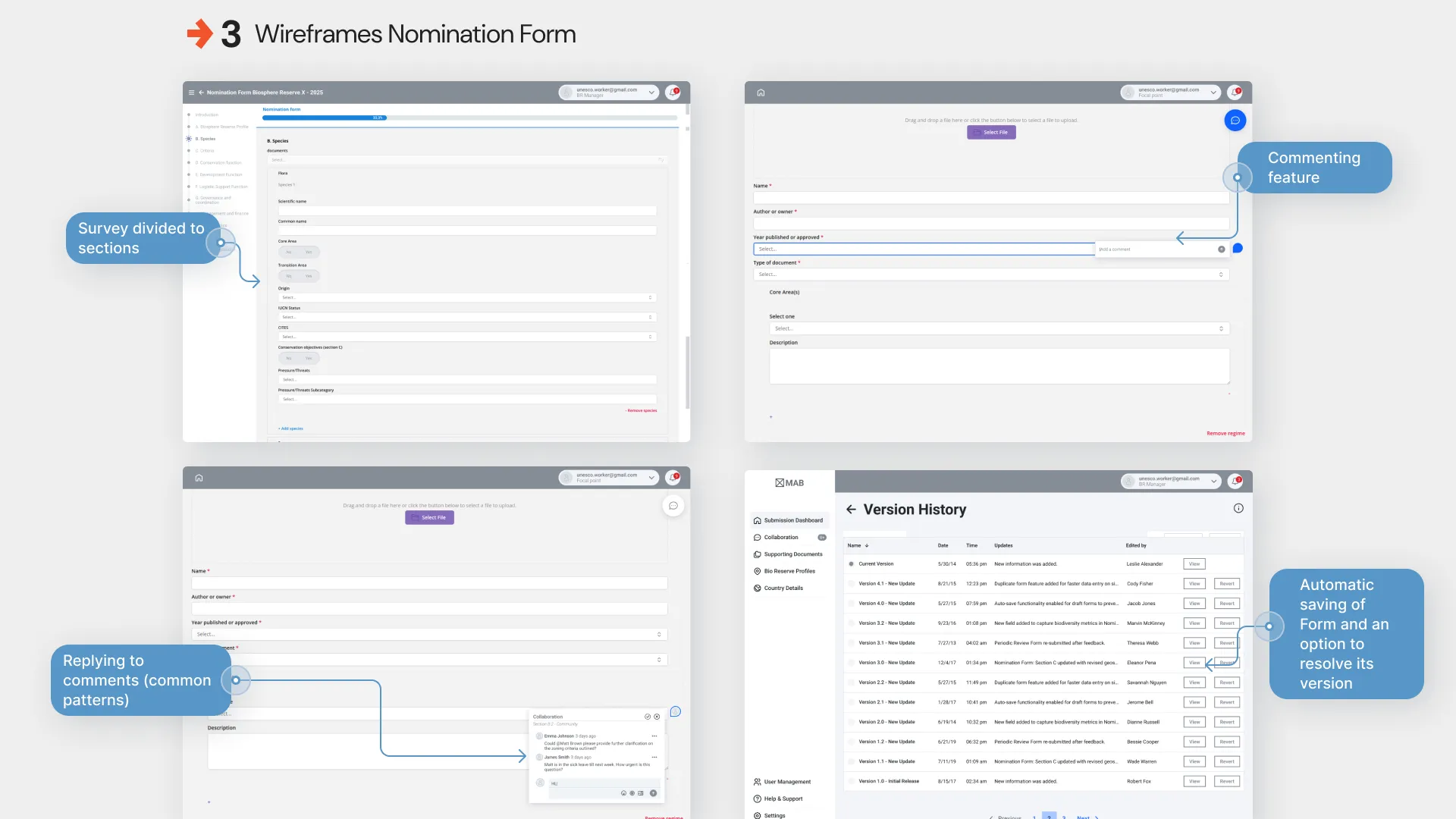
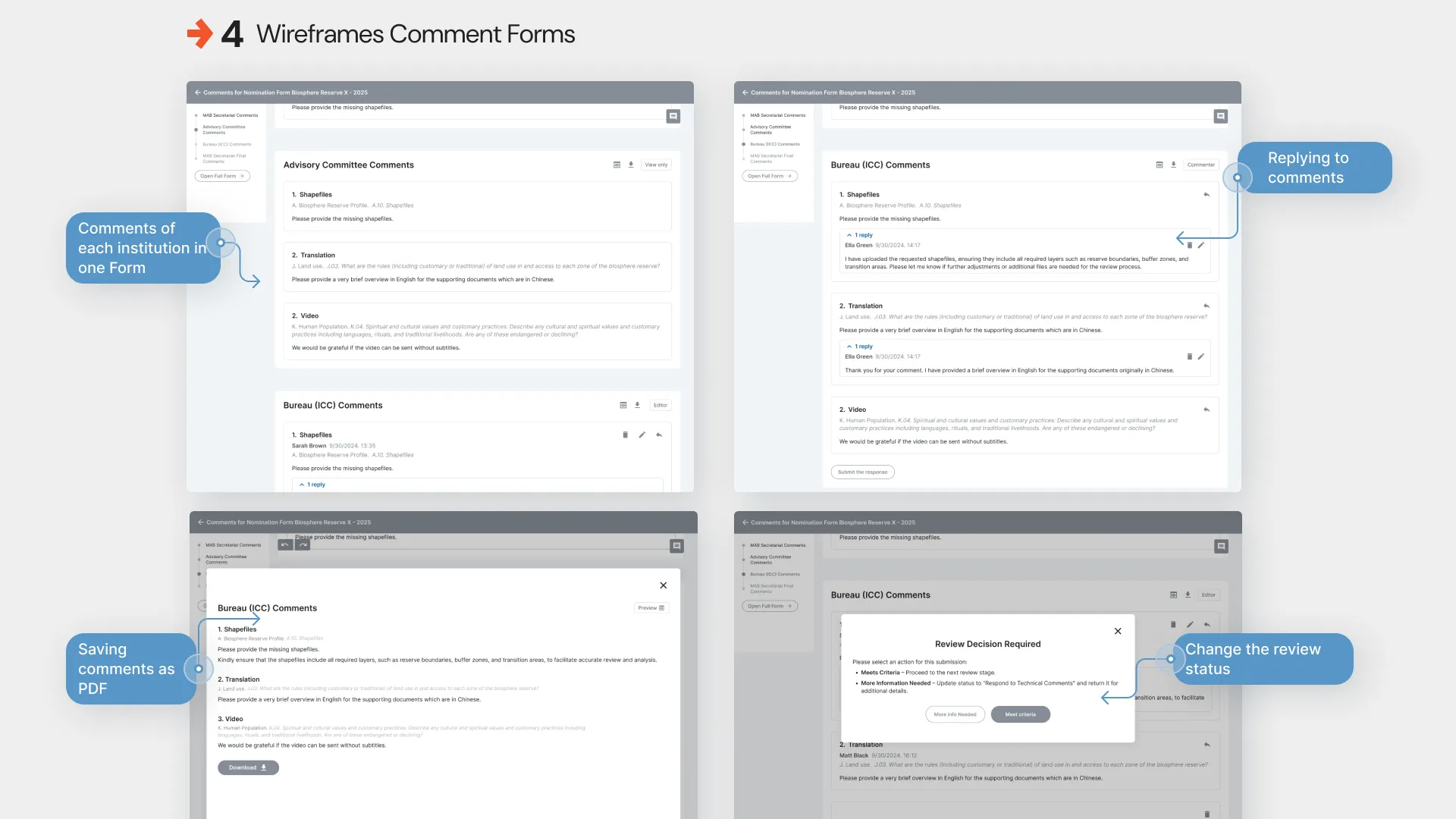
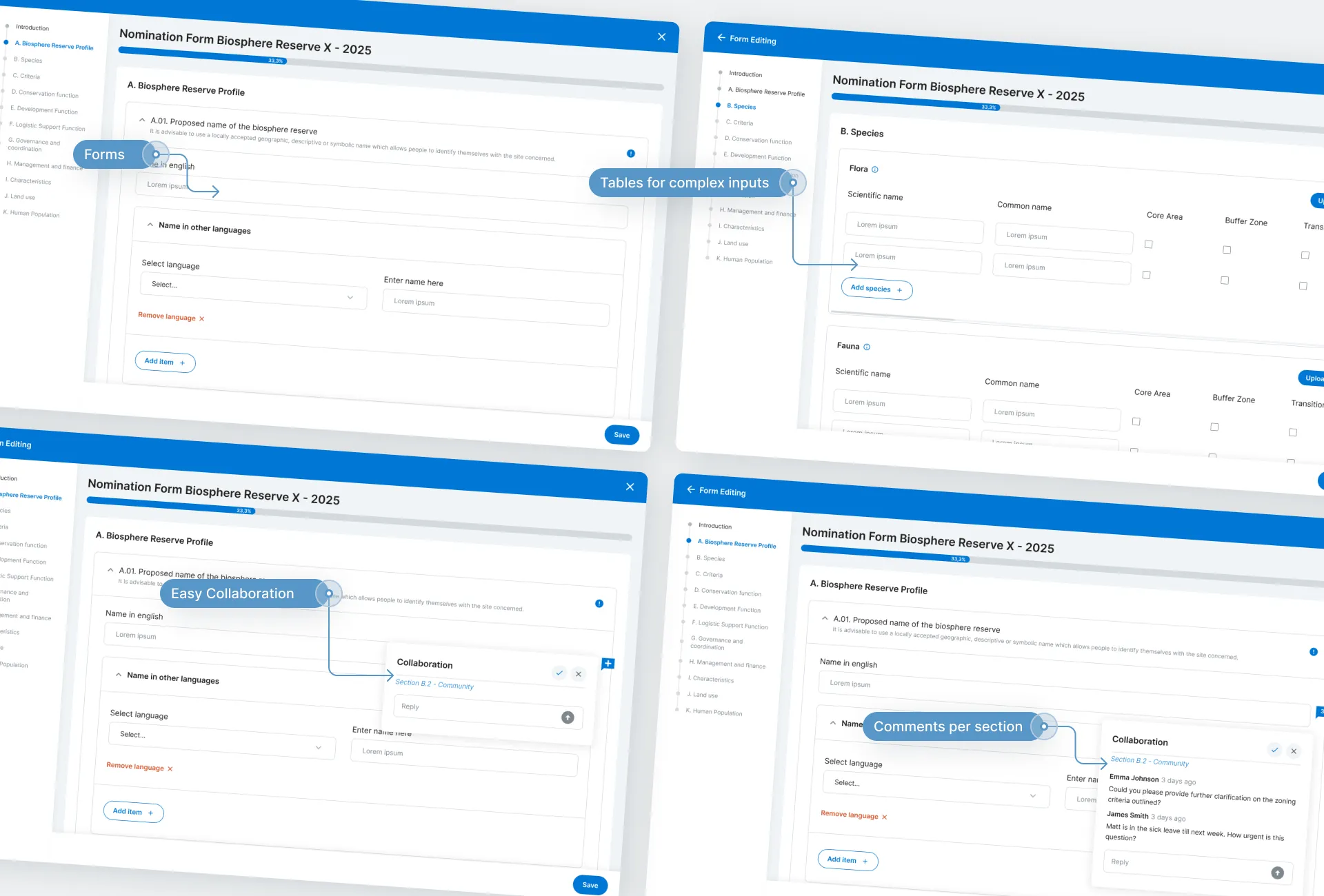
The platform centralises submission, review and approval with role-based workflows. Each role sees the same reserve record and a different set of available actions. Contextual commenting sits on the record itself, so a question about one section stays attached to that section instead of becoming an email thread.
Research
How I Researched it
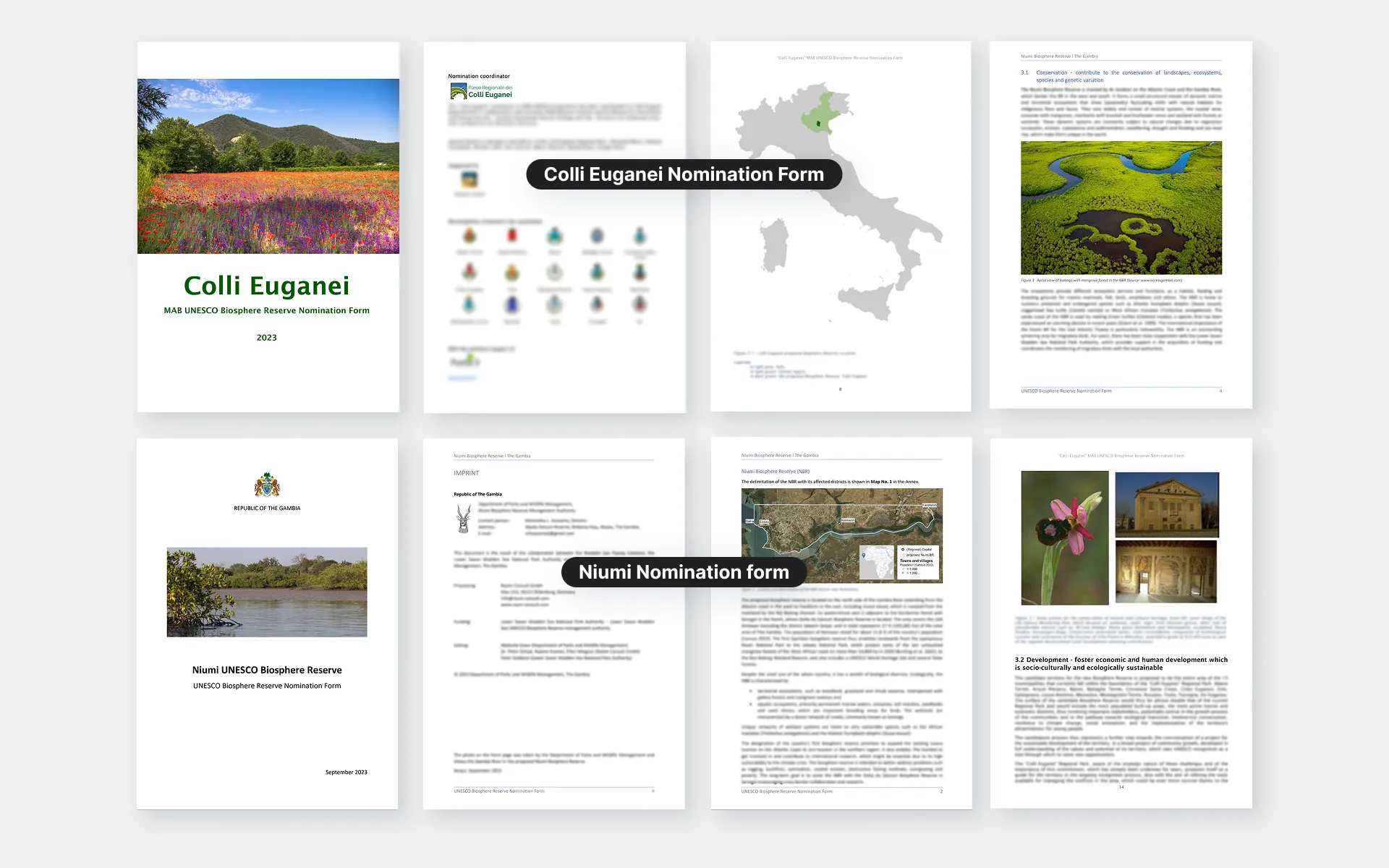
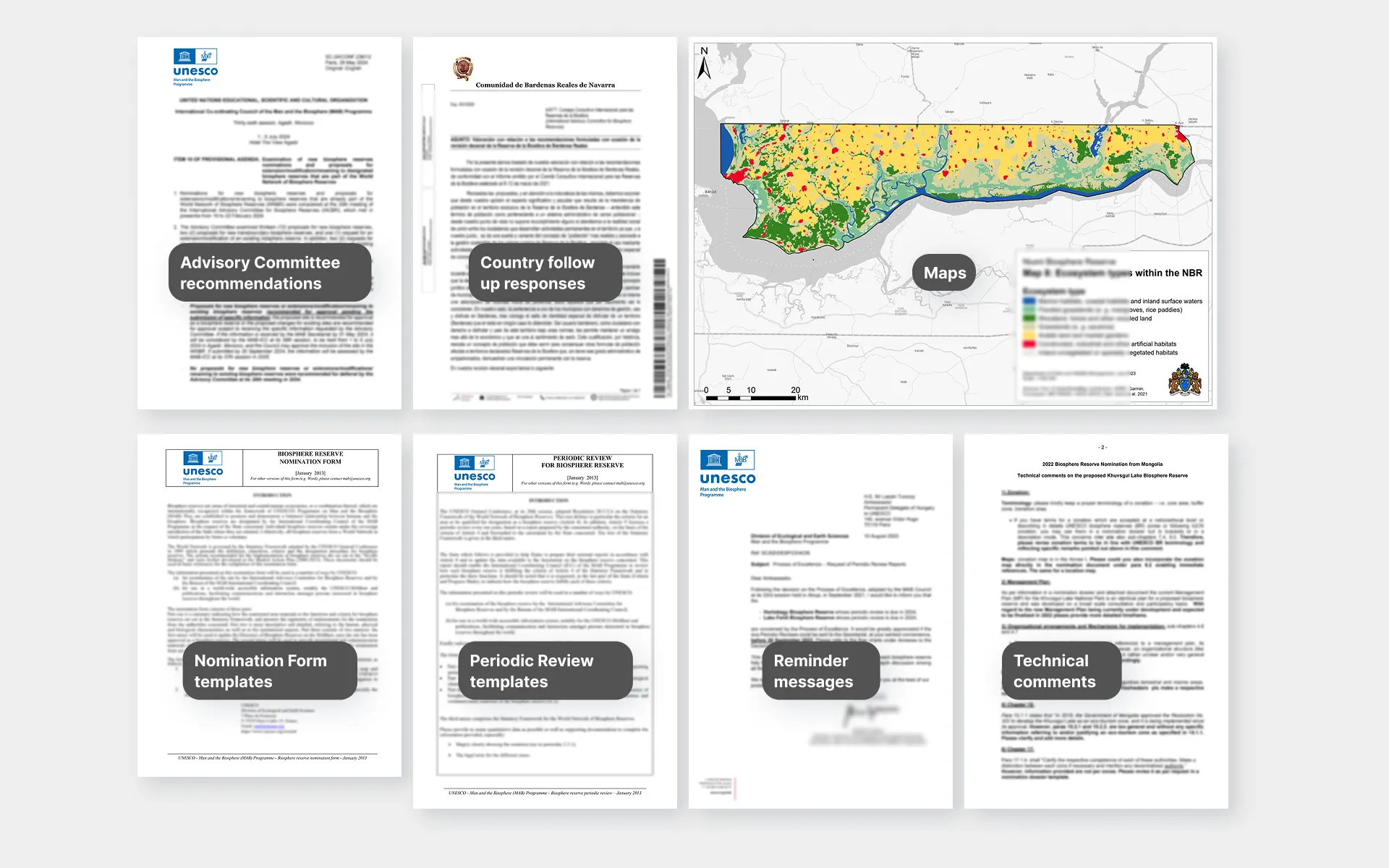
I audited the existing forms and used AI for pattern detection across them, which surfaced the questions countries answered inconsistently and the ones they skipped. I reviewed the programme documentation to map the approval chain and its permissions, then interviewed the MAB Secretariat about where submissions actually stalled.
The Secretariat’s answer was not what the documentation implied. Submissions stalled less at review and more at the point where a reserve needed to revise and resubmit, because nobody told them clearly what to change.
Constraints
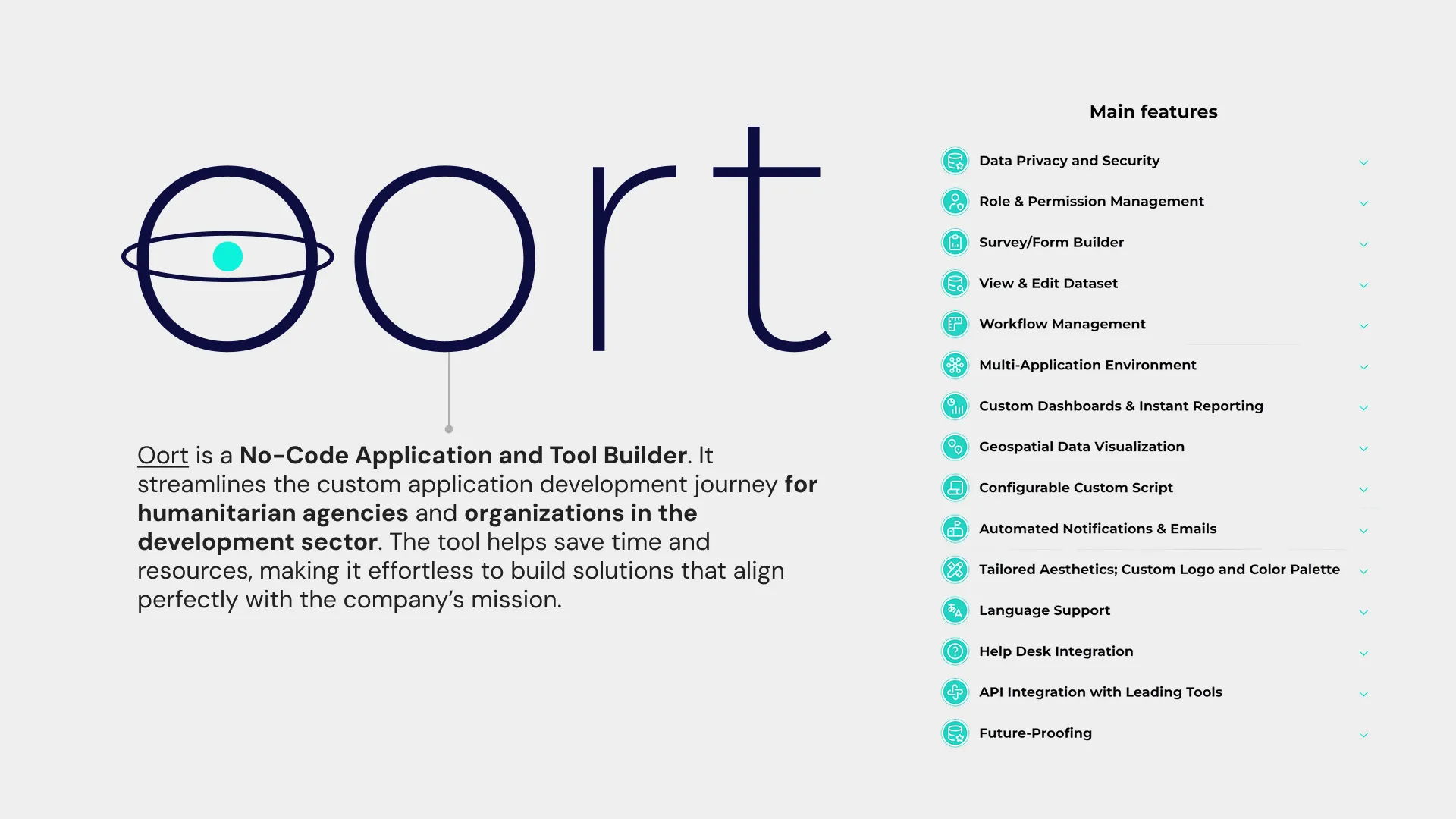
Designing inside Oort
For the UNESCO MAB project, the platform was built on Oort, a no-code system that introduced specific design constraints. While Oort enabled faster development and scalability, it limited layout flexibility, custom interactions, and component variation. This required a design approach focused on clarity, prioritisation, and reuse of existing system components, as well as close collaboration with developers to ensure that complex approval workflows could be implemented within the platform’s technical boundaries without compromising usability.
Design
How I Designed it
User flow
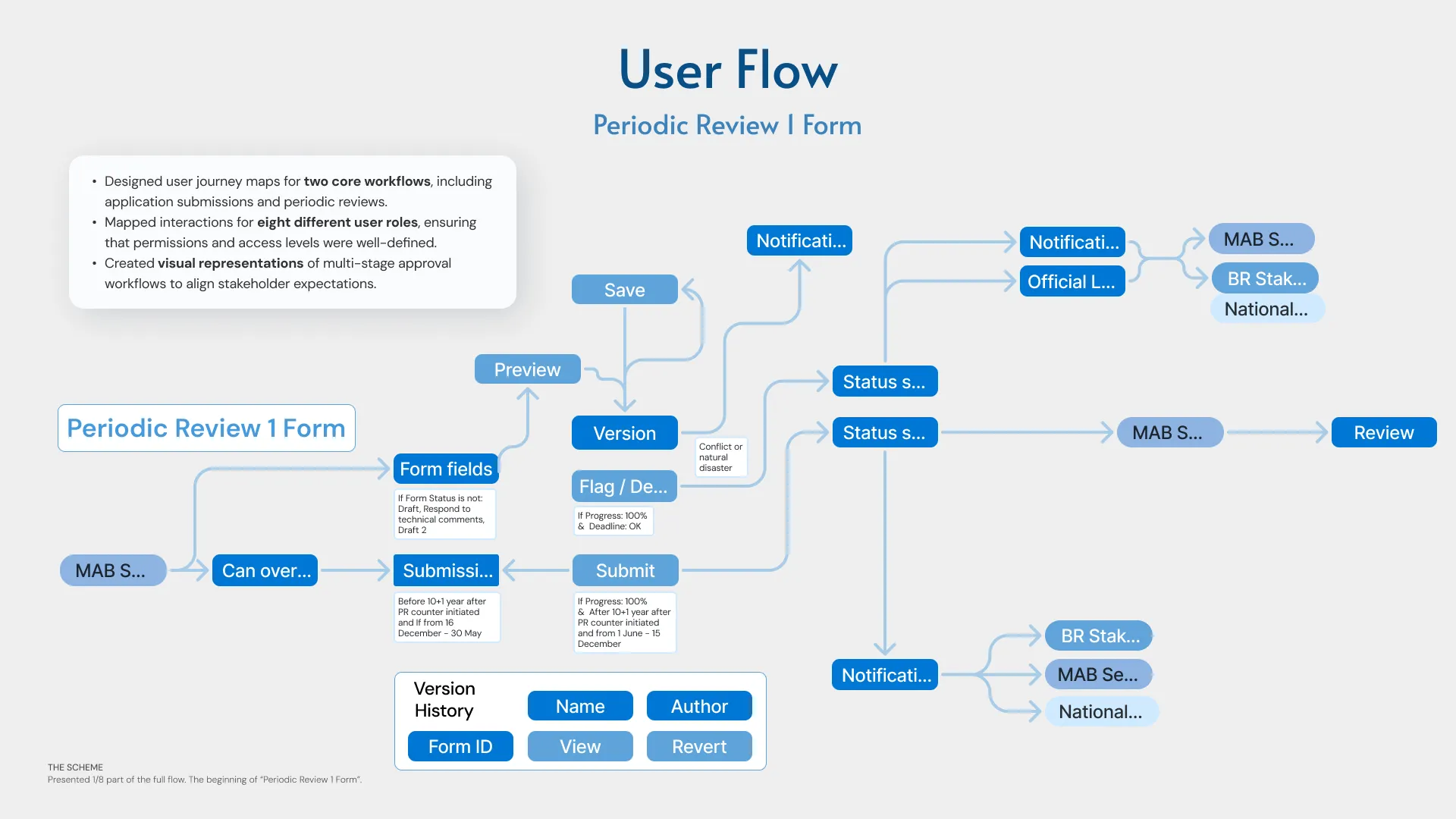
The client documentation ran long, and the job was to turn it into one flow four roles could move through with the right permissions at each step. I concentrated on the two workflows that carry everything else, application submissions and periodic reviews. Four roles across two workflows produce more interaction combinations than I could hold in my head. I built alternative permission models and tested each one against the documented rules, which surfaced the contradictions and the gaps in the source material. The flow here is one modular segment of a much larger architecture, and its job was to give the stakeholders something concrete to agree on.
Wireframes
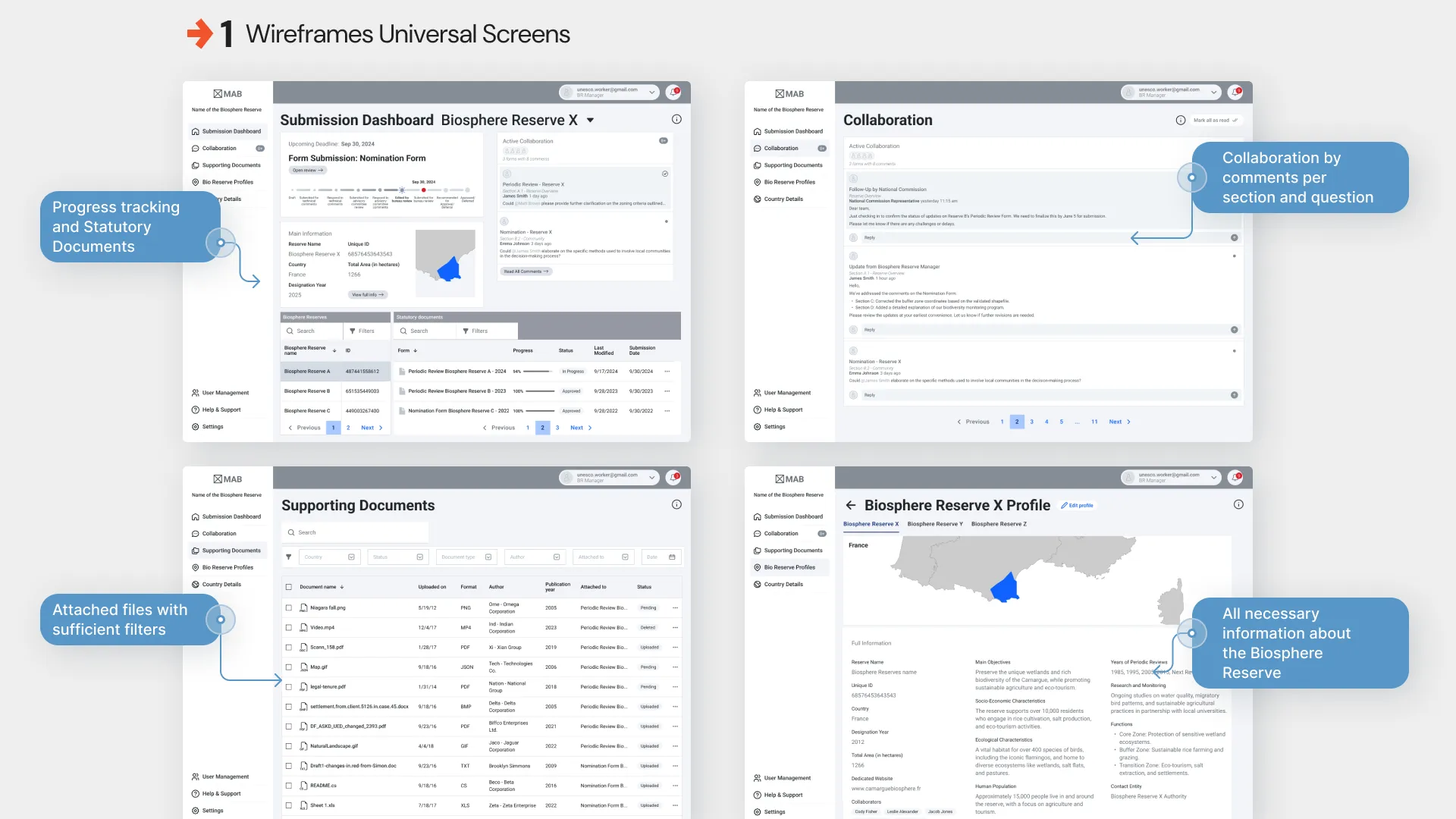
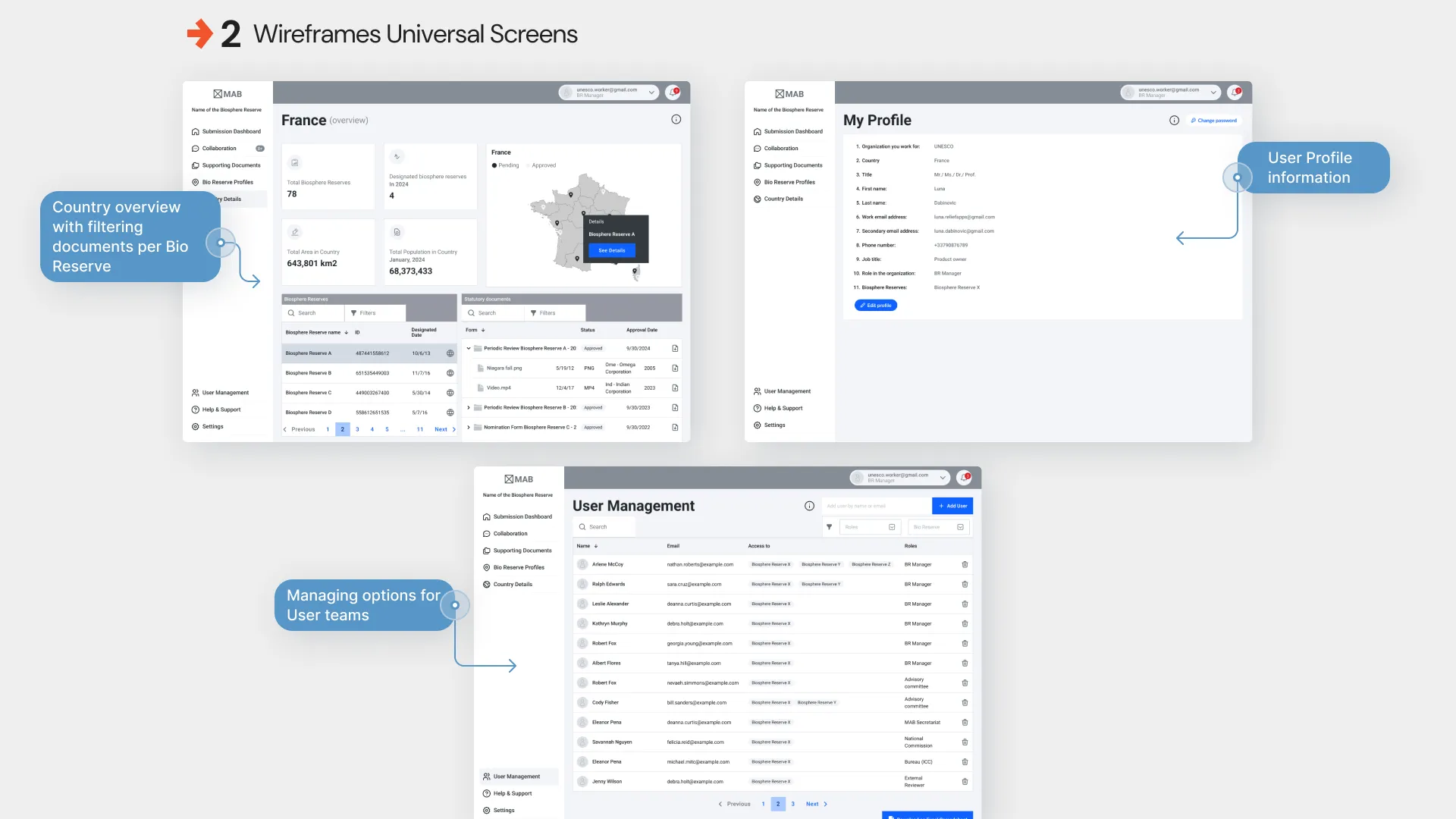
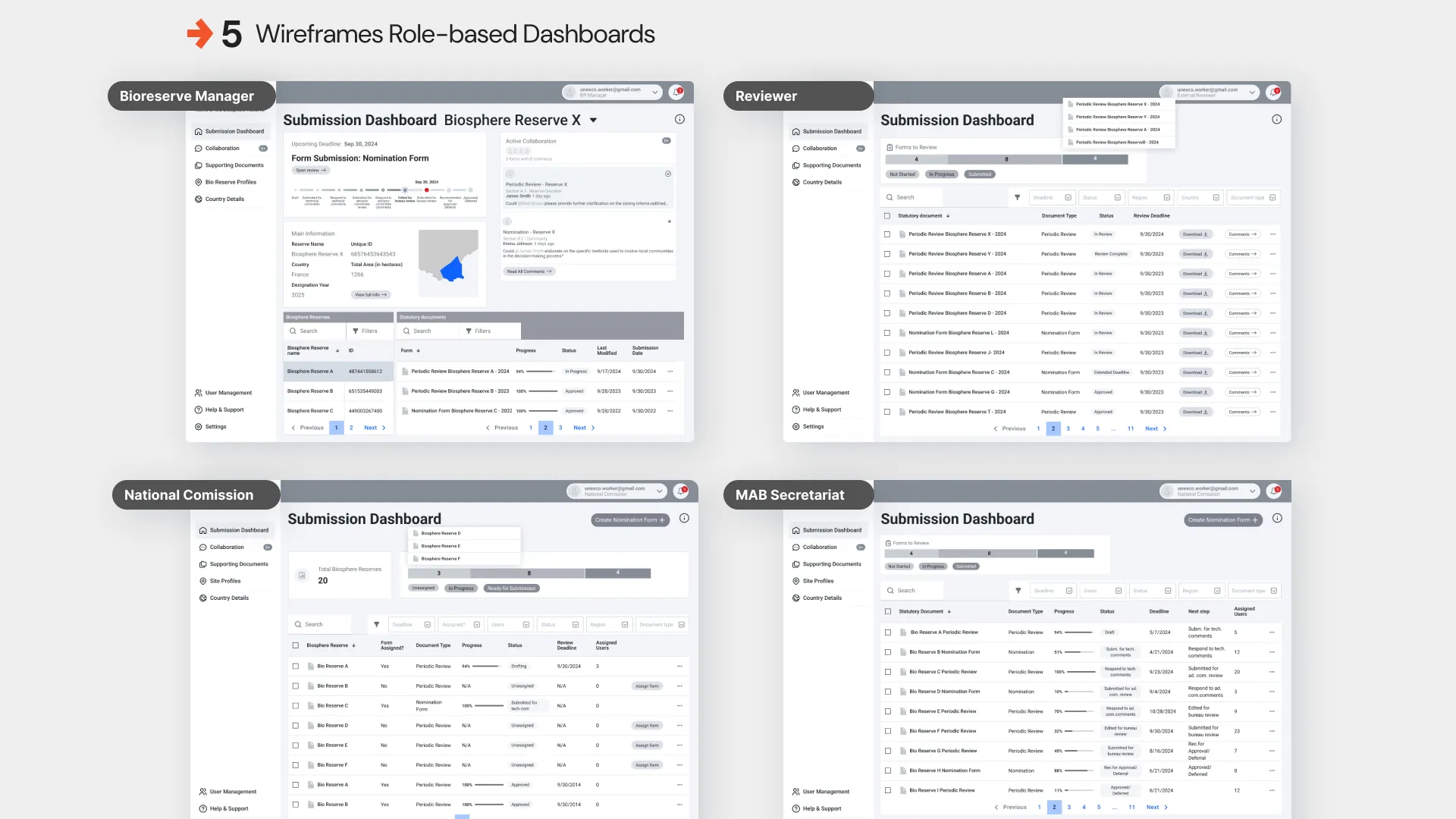
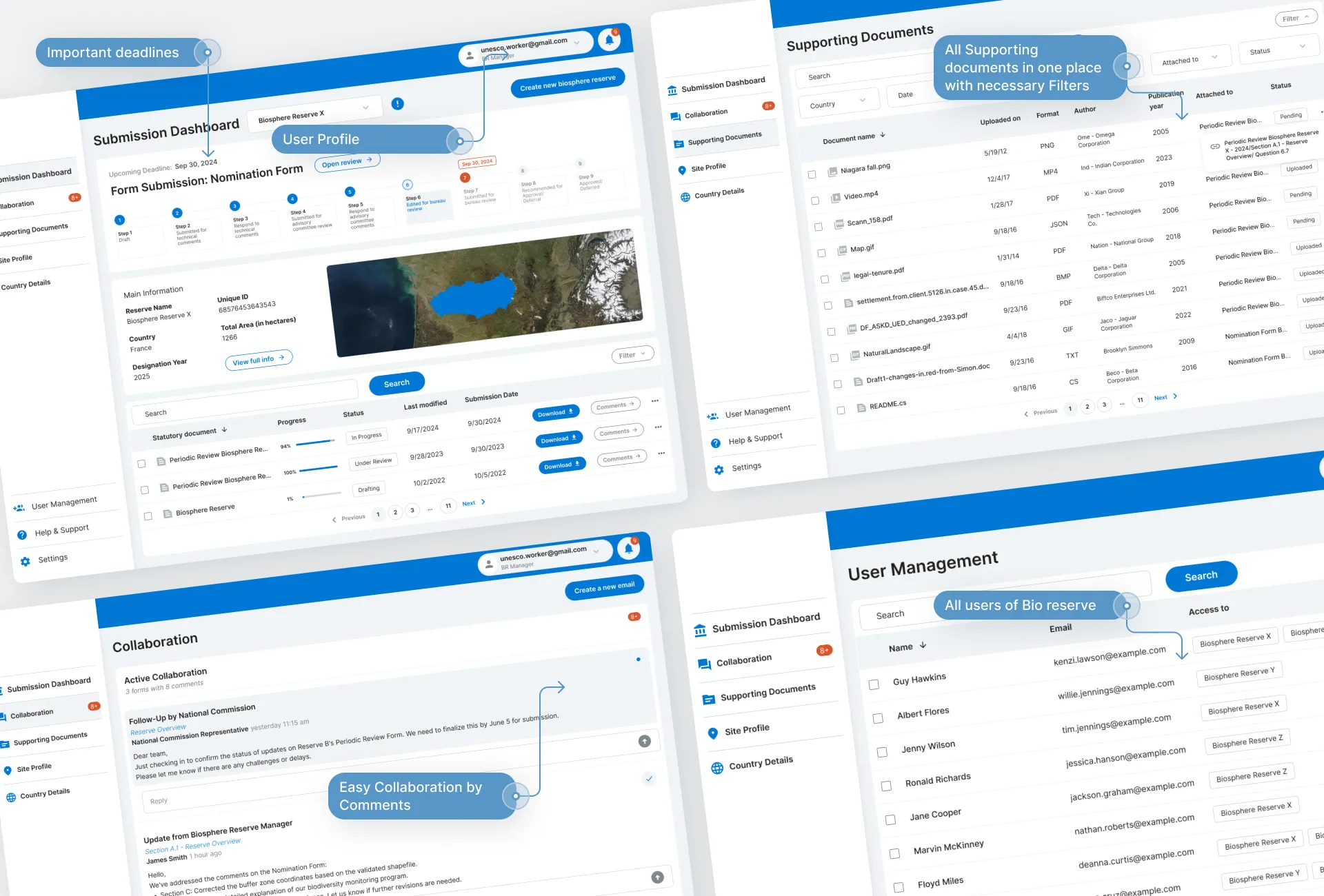
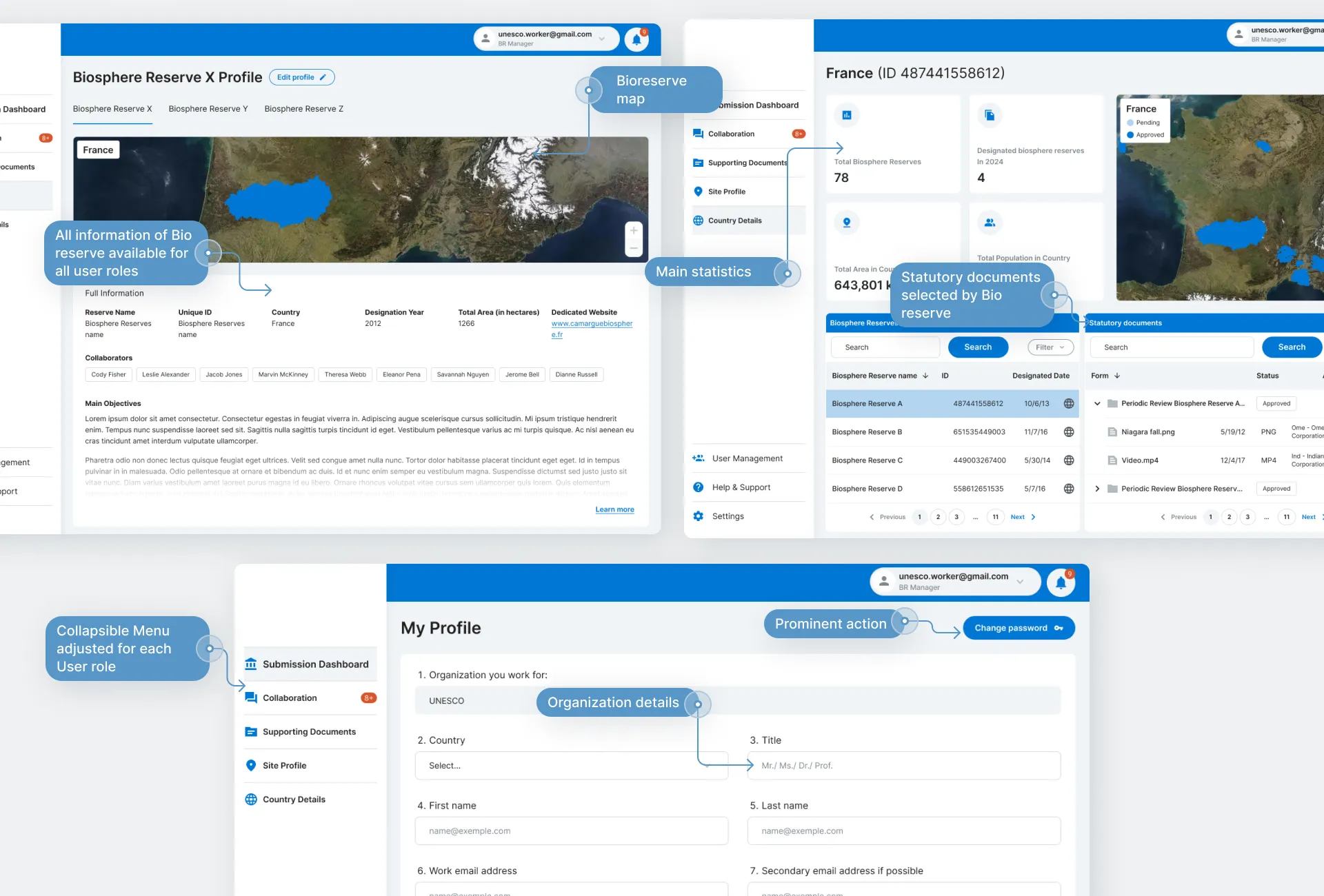
I wireframed the platform as a set of modular dashboards, where the module is a whole page. The country overview, the version history, user management, the submission dashboard, supporting documents, the reserve profile, the nomination form and the comment forms each exist once. A role is a selection from those modules. The Bio Reserve Manager gets the pages for filling in a form and answering the comments on it. The Reviewer and the National Commission get the pages for reading a submission and deciding on it. The MAB Secretariat gets all of them, because it is the only role that sees the whole chain. A change to the version history page then reached every role that had it, which mattered while the developers were assembling those same pages inside Oort.
Design system
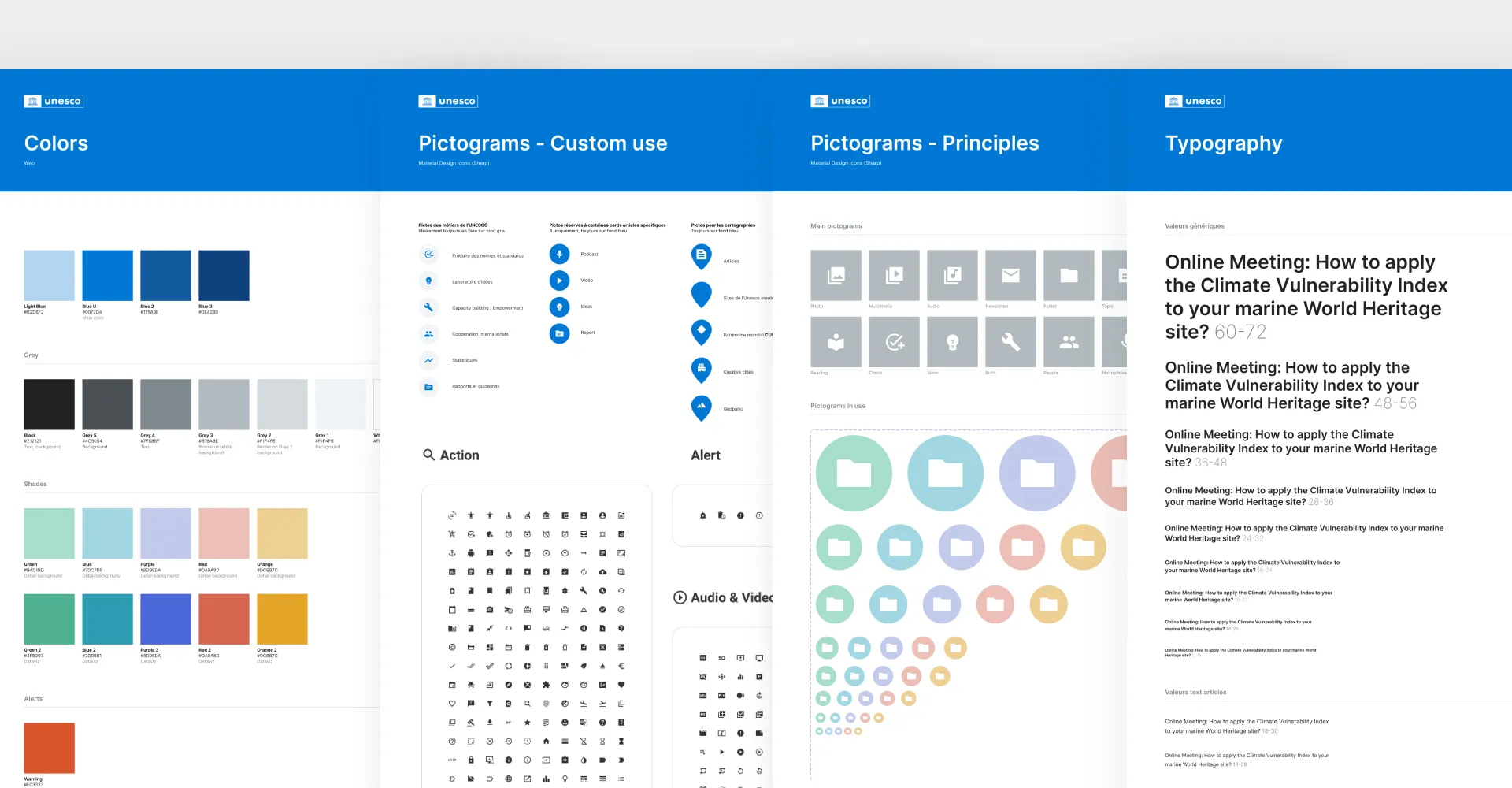
The design system extends UNESCO’s existing brand standards into the components Oort could render.
Iterations
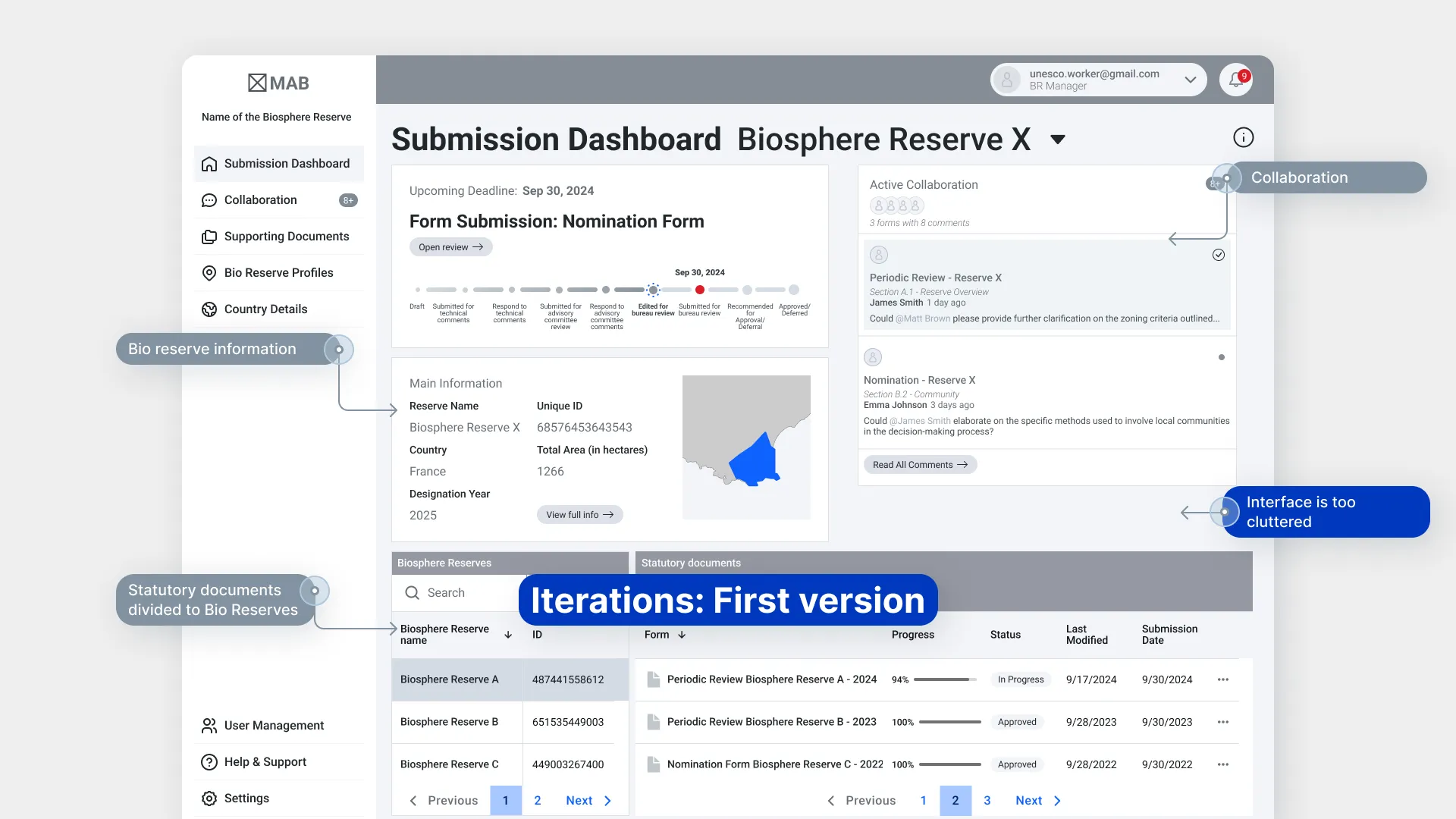
The dashboard, before and after
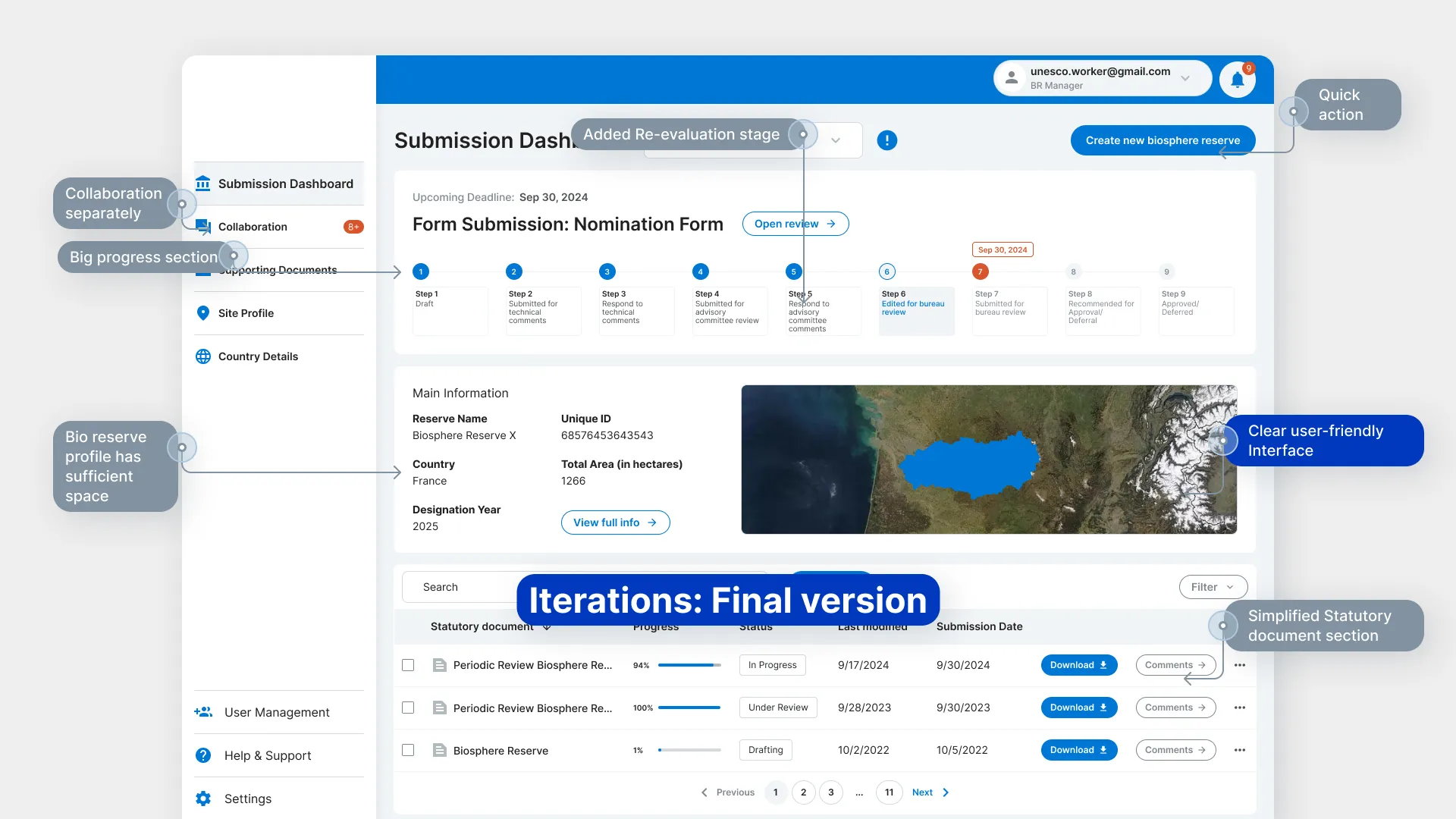
I ran several rounds of proxy user testing with MAB Secretariat members. Each round changed the dashboards. The testing showed where the information hierarchy was unclear, where people could not find the submission they wanted, and which status indicators were missing or read ambiguously. I simplified the layout, made status visible at a glance, and pulled the most important action for each role to the front. The final dashboards support the monitoring, review and coordination work the Secretariat does daily.
Final design
The final platform is built on the UNESCO design system. It holds dense data, and four roles work in it at the same time. The modular dashboards centralise submission tracking and the deadlines attached to it, so a periodic review and an application form sit in one interface. The contextual commenting system answers the communication problem the research found, and it sits inside the documentation flow where the question gets asked. The interactive bioreserve maps and the role-specific collapsible menus each went through several rounds of client feedback, because a screen for high-stakes environmental reporting has to be buildable inside Oort and readable by someone who does this once a year.
Reflection
The platform replaced a document-and-email process with a single record every role can see. Submission errors dropped because the forms now validate at entry, before anything reaches review. Review moves faster because the queue is visible. Contextual comments made the revision step legible, which was the stall the Secretariat had described.
I would want measured numbers here, and I do not have them. The engagement ended at handover, before the platform had run a full reporting cycle.